Monday, January 15, 2018

Nandi Hills - A day trip out of Bengaluru

A day trip to Nandi-Hills is a perennial favorite for Bangaloreans. I had been  there several times during my school and college days and decided to take little Vijay for a summer day-trip.

About Nandi Hills (Wikipedia) or Nandi betta (Anglicised forms include Nandidurg and Nandydoorg) is an ancient hill fortress in southern India, in the Chikkaballapur district of Karnataka state. It is 10 km from Chickballapur town and approximately 60 km from the city of Bengaluru. The hills are nestled near the town of Nandi. In traditional belief, the hills are the origin of the Arkavathy river.

Our visit : 22 April 2017

Mode of transport: One can drive down from Bangalore or take a bus. We decided to avoid driving and took the KSRTC bus from Bangalore. Direct bus from KBS to the top of hill leaves at 8 AM and if you miss it, you can take a bus to Chikkaballapur from where there are frequent buses to Nandi Hills.

Tips: Whether you drive or take a bus, you may have to walk a few kilometers (up the stairs along the hilloc); be prepared.  Not many food outlets on the hill. A couple of shops near the bus stop sell Chips, snacks and ice cream.


A few pictures from our visit 


Father and Son

Walking Trail up the hill

Get closer to Nature

And a selfie with Suja

The only eatery on the hill: near the bus-stop


Note to self: The area around the Nandi-Hills are getting commercialized. Lot of builders and developers have taken over pristine farmlands and converted them into plots, some of which are being sold as 'hill view.' I am not sure who would want to live 60-kilometers from Bangalore in an area that is yet to develop but I guess those investing are doing so for the 'future' Caveat emptor; buyer beware. 

Thursday, January 11, 2018

Aadhaar, a Unique ID for a Billion people: is it time to fall behind and move forward ?

Among the first documents you will have to acquire after you happen to migrate to the US or Canada is a Social Security/Insurance Number (SSN or SIN). This number is required for almost every public transaction starting from employment verification, payroll and taxes, engaging with financial institutions, banks and other businesses.

You will need the nine-digit number to apply for a driver’s license. Your landlord will ask for it to do a background check before renting you an apartment. Same goes for a bank or financial institution you wish to transact with. Although its primary purpose is to track individuals for Social Security purposes, the SSN has become a de facto national identification number in America for taxation and other purposes.

If like me, if you happen to be a returning-NRI, the similarity between the ubiquitous use of an SSN and Aadhaar in India will be striking. An Aadhaar card with a picture and bio-metric data takes it a step further from the SSN card.

After returning to India last year, my wife, son and I had to apply for an Aadhaar; and the application process was almost effortless. (link) We walked into a local ‘Bangalore one’ center with a couple of required documents and in about half-hour had completed the process. I got an SMS a few weeks later stating that our application had been approved, and received the card by post a few weeks after that.

Image result for aadhaar

Prior to migrating out of India, I had a PAN card, and a driving license, but it seems that for all practical purposes, an Aadhaar has become the de facto 'government id' document to have.

Identity for a billion people 


Growing up in India in the seventies and eighties, I remember the hoops the common-man used to jump through to acquire a government issued id. Ration cards were coveted documents issued selectively since they gave the holder the privilege of subsidized food-grains, rice, wheat, sugar, kerosene etc. PAN cards were the domain of the salaried class – primarily folks who paid income tax. Voter ID cards, driving licenses and other documents were selectively used by people who had access to them.

The common man neither had a permanent-roof over his head nor the documents to prove his residence and would spend a lifetime without a proof of identity.

On returning back to India recently, I was pleasantly surprised to see the pervasiveness of Aadhaar. Almost all urban residents from all walks of life seem to possess one. And those without it are slowly but steadily applying for it to ensure they can operate a bank account and continue to use a cellphone.

Of course, like many other digirati, I have also been following the controversy over Aadhaar and issues over privacy, though at times I am left wondering if all this is a storm in a teacup.

Privacy is a serious issue 


Citizens in western countries with SSN like systems are acutely aware of privacy issues surrounding digital identities and continue to address them. Identity theft happens at such a large scale that an entire industry has sprung up around “identity protection.” At periodic intervals, one reads of major security breaches at banks, financial institutions, retailers and other places of business. In 2017, sensitive personal information concerning 143 million American consumers with credit records was ‘exposed’ in a massive data breach at Equifax, one of the nation’s three major credit reporting agencies.

News of the breach led to a lot of outcry and congressional inquiries. While residents question the potential misuse and security breaches, the use of SSN as an individual’s primary source of identity is institutionalized and generally goes unquestioned.

Residents who want to deal with government agencies, financial and private organizations generally don’t have an option but to use the number. Technically, like an Aadhaar, the use of an SSN for nongovernmental transactions is voluntary, but guess how many Americans will risk turning down a loan offer, or a job just because they don’t wish, or are afraid to share their Social Security Number? Not as many as you think.

Issues surrounding privacy, and use of data certainly raises questions that policy makers need to address. A cross-section of Indians, however, seem to be finding fundamental issues with Aadhaar and the policies surrounding its implementation. As per media accounts, a number of petitions pending before the Indian supreme court include:
  • Petitions against making Aadhaar mandatory for social welfare schemes: Shantha Sinha & Anr. v. Union of India (W.P. (C) 342/2017) 
  • Pan card and Income Tax (Section 139AA): Binoy Visman v. Union of India (WP(C) 247/2017) and S.G. Vombatkere & Anr. v. Union of India (W.P.(C) 277/2017) 
  • Infringement of Right to Privacy (Article 21): Justice K.S. Puttaswamy (Retd.) & Another v. Union of India (WP(C) 494/2012
  • Aadhar Act passed as a Money Bill: Jairam Ramesh v. Union of India (W.P.(C) 231/2016)
Some are questioning if this is a ‘voluntary’ or ‘mandatory’ Unique ID issued to residents of the country. Again, drawing parallels with the American SSN, let us make a hypothetical argument that acquiring and using an Aadhaar is ‘voluntary.’ Even if one assumes the use of Aadhaar is voluntary but continues to be pervasive as a basic proof of identity, one wonders how many Indians will stand on principles alone and refuse to use the UID? Perhaps a minority of the intelligentsia, with those with the mean and resources to acquire an alternate ID – a passport or a PAN card will.

Time to move forward, not look back


It is hard to say if the government will address all the challenges surrounding Aadhaar but one thing is for sure: rolling back to a time before Aadhaar like UID for Indians is unthinkable.

In the twenty-first century, a country with over billion citizen needs a centralized Unique Identification (UID) for its citizen. We are better off agreeing on the need for the Unique Identification, and focus our energies in ensuring its judicious use, and add checks-and-balances to ensure a design for privacy surrounding digital identities.

Sunday, December 24, 2017

A visit to 43rd Annual Cake Show, Bengaluru 2017

As of December 2017, the popular 43rd Annual Cake Show is back at St.Josephs School Grounds in Bengaluru.

We decided to visit the exhibition on Christmas eve (Sunday evening) and it seems like most parents in the city had the same idea. The place was really crowded and the bouncers had a tough time managing the long queues.


Topica exibit: celebrating Virat Kohli and Anushka Sharma's  wedding 


And a few more picture


So, what's a show without a family selfie


Event Date 15-Dec-2017 to 01-Jan-2018
Where : St.Josephs School Grounds
Entrance fee: Rs 60/head
Organized by : ncfexhibition 

Sunday, December 17, 2017

Top 10 technology trends to watch in 2018

Emerging Digital technologies will continue to dominate technology investments in 2018. In this report, we highlight 10 technology trends likely to have the most impact on businesses in the year ahead.
  • Corporate Digitization – Technologies have continued to mature in 2017 and ‘digitization’ has moved beyond a buzzword. Business and tech executives continue to execute ‘digital transformations’ that bring greater automation, user-self-service, and enable advanced eCommerce and SMAC techniques to engage with customers.
  • Artificial Intelligence (AI), Machine Learning and Cognitive technologies – Tech analysts will remember 2017 as the year when business world finally started getting serious about the disruptive potential of AI. The tech Oligopoly – Apple, Amazon, Facebook, Google and Microsoft – announced large investments in AI and began showcasing solution offerings for consumers and businesses. 2018 is also likely to see startups, tech-service firms and the academia addressing the skill shortage.
  • Big Data – Analytics, aggregation and visualization – We create 2.5 quintillion bytes of data every day; and over 90% of the data in the world today has been created in the last two years alone. As the challenges of big-data are being understood, innovative applications are highlighting potential to glean insights from the aggregated sources.
  • Internet of Things (IoT) – Internet of Things (IoT) holds a lot of promise in machine-to-machine communication enabling ‘smart’ devices. IoT is really an aggregation of technologies with sensors that gather data, machine-to-machine communication and networks to a ‘gateway,’ big-data and analytics to enable storage, analysis and review of the findings. Innovative ideas range from applications in wearables, smartphones, smart meters, vehicles, factories, machines to other places where imagination takes us.
  • Immersive Experiences, Virtual Reality and gaming – A combination of immersive and Virtual Reality technologies have been raising consumer expectations of video games. These technologies, enabled by advances in hardware and high performance computers, are beginning to blur the line between the physical, digital and simulated worlds, creating a sense of immersion.
  • Voice recognition and Voice Activated UI – Adoption of voice recognition and voice activated technologies have been advancing at a fast pace. Voice based applications in the corporate world are also continuing to make strides. Widespread adoption of Interactive voice response (IVR) at call centers and for CRM based solutions are beginning to enhance productivity by allowing computers to interact with humans through the use of voice input.
  • Blockchain – Bitcoin technology – The blockchain technology – popularized by digital currency Bitcoin – is increasingly being used to enable trust across industries. The underlying blockchain technology is a trust based protocol enabled by globally distributed, secure platform that enables a ledger or database where value could be stored and exchanged without powerful intermediaries.
  • Technologies from Self-Driving cars – Auto manufacturers, ride share and technology companies are advancing research and development of self-driving cars. 2017 also saw a lot of mergers and buyout of niche technology companies. Autonomous vehicles are the leading edge of artificial intelligence investment and development and investments in that sector is a precursor of things to come in fields like natural language processing, image recognition, and others as these technologies gain commercial momentum.
  • Robotics and automation – Automation, and use of bots aided by emerging techniques like artificial intelligence and machine learning are advancing at fast pace. Intelligent machines and ‘bots’ are already being employed in ways we never thought possible a few years ago. However, automation and robotics continues to be niche and fragmented business. Most large companies and manufacturers aggregate and integrate services from small, niche suppliers innovating on automation and robotics.
  • Enabling Digitization – Organizations are interested in solving specific problems using some of these technologies. Such corporate digitization efforts translate to opportunity for consultants, system-integrators and software product development firms.

A PDF copy of the report is available for FREE download: http://www.mydigitalstartup.net/top10trends2018/

Wednesday, December 6, 2017

Caregiving for elders and senior citizen in India - Observations and trends


Many of us take on the responsibility for parents and family members when they age. There was an interesting article in the New York Times a few weeks ago highlighting this trend "Old and Lonely in New India." However, unlike some of the people quoted in the NYT article, I decided on a different course of action and relocated back to India. 

About a year ago my wife and took the plunge and moved back from the US to take care of my aging parents. (link to my blog on the move) In the year gone by, I have been reflecting on my experiences with the growing cottage industry around elder-care in urban India.

A generation or two ago, it was quite common for joint families – three or even four – generations to live together. One would frequently come across middle class families with grandparents living with uncles, aunts, cousins and siblings with their kids. In many cases, the families would live in a large house, under one roof or in a compound with conjoint units.

Festivals and celebrations would be a joint affair, and there was an informal division of labor when it came to household chores. Some finances, resources and effort would be pooled in without much thought or effort since it was the norm and expected. The communal process was also designed to provide for care and support of children and elderly in the family. Even when families didn’t live together under one roof, they lived in close proximity – perhaps the same village or town – giving them a sense of belonging and being there for each other.
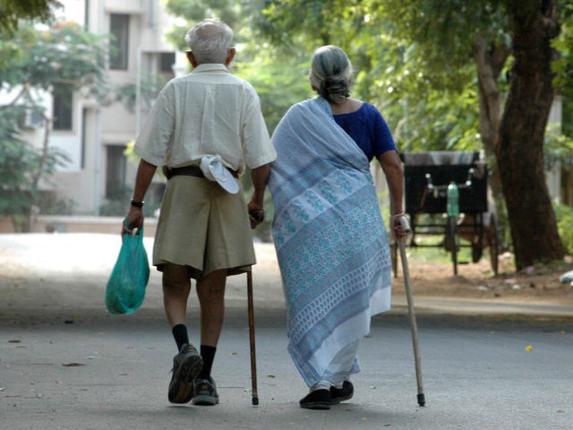
Image result for old age india
googled image


Demographic shift: two sides of a shifting coin


India is certainly a youthful country with a large population. With over 350 million 10-24 year-olds, India has the world’s largest youth population; and over 70 percent of Indian population is under 35 years. Thanks to improved access to medical care and increased affluence of the population, the life expectancy of senior citizen in the country continues to rise. Many seniors are also living well into their eighties and nineties, which bodes well for elders if the earlier social support model had continued.

In the past couple of decades, the Indian society has transformed. Rapid and widespread urbanization, migration of population from villages to cities, and emigration of the younger generation to western countries has changed the social fabric considerably. Younger generation of Indians are increasingly aping western model of independence and self reliance, leaving home as soon as they are ready for college, and then continuing to pursue their jobs and careers wherever opportunities beacon.  
The logistics and expectations of senior care in India, however, has not kept pace with the change in the society. 

In the west, the fragmenting of joint families was accompanied by an emergence of senior-care system across a wide spectrum. Care giving for seniors is a serious and lucrative business. Organizations and entrepreneurs provide services ranging from senior living apartments and condos, assisted living homes to a network of hospice and terminal care systems. This has led to a large network of service providers focused on various aspects of home-healthcare to meet medical and caregiving needs. These facilities are designed to accommodate people from across social, economic and demographic segments.

Senior citizen in the west willingly – or sometimes goaded by family members – move from one stage of elder-care to the next as their physical faculties and abilities change as they age. Such changes are generally accompanied by downsizing of one’s house, assets and other amenities of life. 
One can argue that much of the senior-care is ‘outsourced’ without emotions and encumbrance by family members. The society has begun to accept this as a norm and people begin saving for their own retirement and old-age. In some western countries, personal savings are supplemented by an advanced system of social security that comes handy for a variety of senior needs.

Emergence of old-age care in India


Young, Indian nuclear families who opt to live away from extended families and hometowns still feel obligated to support their elders but are unable or unwilling to take on such responsibilities that might weigh down their lives and careers. As the society transforms, the Indian middle class is beginning to explore a wider range of elder-care facilities to accommodate their eclectic needs. This translates to an increased demand for elder-care and home-care services.

Old age homes, that in earlier generations were the last refuge for poor and destitute are starting to transform. Many “old age” homes are being designed to cater to the needs and desires of the urbane, affluent middle class and also the needs of the NRI community. Some of them advertise modern amenities, 24-hour care and security along with communal facilities including access to nursing and medical care. Some facilities in larger cities also advertise “elder day care” where one can drop off elders during the day to engage and entertain with fellow seniors.

Builders and property developers are beginning to capitalize on this opportunity to develop flats and communities for ‘senior living.’  The sweet-spot is the relatively affluent class of empty-nesters and newly retired senior citizen in their sixties who are looking to downsize from their flats and villas to planned senior communities.

Such planned senior-living communities and old-age homes address only a small segment of the needs, especially since senior citizen have unique health and other challenges. Much as we desire to maintain good health as long as we live, nature and age takes its toll. No two seniors age in the same way. Disease ranging from benign aches and pains and temporary loss of memory to more serious cancers can derail the best laid retirement plans.  Ailments that incapacitate and cripple elders can be excruciating. Such a crippling of physical faculties can affect the morale of the elders, while also draining the energy and resources of the families that unwittingly get sucked into the role of caregivers.

My father, a proud veteran of the Indian Air Force enjoyed a relatively good health well into his seventies after retiring from service. He and my mother enjoyed their golden years living alone in an independent house and frequently traveled to temple towns across South India. All this slowed down after my dad was diagnosed with Prostate Cancer – in itself not a life-threatening condition. However, in quick succession he was also diagnosed with Parkinsons, that began impacting his motor skills and physical movements. While he was mobile and active during the day, he needed help with diaper change at night and to escort him for his morning walks. After a few phone calls and quick research, I engaged a caregiver from an independent agent who had provided a similar service for a relative’s family.

The middle-aged lady, Kamala, would come at around 8 in the evening and spend the night at home and after the morning walk and breakfast with dad, would leave. Her temperament was well balanced and she brought in a rich background in caregiving from her previous experiences. This setup continued for about a year, before my dads’ condition abruptly took a nosedive after a mild stroke, when he was hospitalized. After a few weeks in the hospital, he was discharged and advised homecare where he continued to be bedridden.

We realized that the night-caregiver wouldn’t be sufficient and that Kamala alone wouldn’t be able to manage my father’s advanced needs. After additional word-of-mouth research, I decided to engage a live-in caregiver from another small organization.  

Bottomline: The newer generation of elders, caught between rapid urbanization and prevalence of nuclear families is realizing that they need to be more involved in planning for their own sunset years and many not have the social support previous generations enjoyed. However, without an advanced network of providers catering to needs of seniors, those who can, still fall back on their families. It still takes a village to care for an elder; though an increasingly affluent middle-class has to pay for the village! 

Wednesday, November 29, 2017

Here is why Enterprise Architects need a quick primer in Finance, Costs and P&L

I periodically engage in digital forums discussing the practice of Enterprise Architecture and Technology Management. Many of the conversations focus on EA building blocks, domains and on aspirations like getting a ‘seat at the table,’ closer engagement with business. However, such aspirations remain academic, unless substantiated by business fundamentals including an understanding of costs and financials.
The goal of a commercial enterprise is rather straightforward: maximize shareholder value, and increase returns for investors. Most other goals, including profit generation and operational excellence are inherent in this. However, cost and financial reviews are generally absent during Enterprise Architecture reviews. Even EA frameworks - including TOGAF, Zachman – miss the big elephant in the room or deliberately underplay it.

What is the cost of your roadmap realization?

This rather simple sounding question is likely to stump many Enterprise Architects, and leave them fumbling for a response. Even when an EA has some information on costs, s/he can easily get overwhelmed when the discussions get deeper into TCO, financials of the Business case, levers impacting the business value or a discussion on CapEx and OpEx that ultimately drive the P&L. To be fair, defining Architecture roadmaps for BDAT, functional and technical domains can be a rather involved exercise. During such Architecture reviews, practitioners might make a lot of assumptions and SWAGs and may not get down to the costs and financials. 
In an earlier blog post (link), I described the process of reconciling EA roadmaps across functional and technology domains. Such reconciliation of roadmaps and capabilities across the landscape requires the extended team to agree on a few criteria, including a common table of contents (TOC), guiding principles and capture of the requirements, assumptions, timelines and other building blocks.
During roadmap reconciliation, Architects engage with their stakeholders to validate their assumptions, drivers and timelines. This is also an opportune time to engage in conversations on the cost and benefits of capability realization since KPIs, and success factors are generally tied to financials.  
I have engaged with business partners and stakeholders at various stages of digital transformation - from ideation to the translation of such strategies into actionable programs and projects (link). In many cases, the conversations remain at a ‘ballpark’ and SWAG level and might get less ambiguous as the programs evolve. However, Enterprise Architecture inputs are required while strategies translate to programs not after that.

Case in point: Cost benefits of migrating a portfolio to the cloud

A few years ago, my organization decided to move forward with a cloud migration plan, and I took on the responsibility for assessing the portfolio of 2000+ application platforms. The ‘cloud suitability’ assessment of individual platforms unearthed unique challenges and dependencies across the landscape. The underlying cost of platforms including application support, hosting and infrastructure, and complex licensing costs were shared across the landscape. Some of the costs and licenses had been negotiated years ago. While individual application owners understood and tracked the cost of ‘their’ applications, most of the shared costs were tracked globally. A phased migration to the selected cloud options – IaaS, Paas and SaaS – would upend the status quo.
It was obvious that a summary of the transformation cost had to be communicated to the stakeholders. An early review of the TCO and an understanding of the different levers of ‘cost benefits’ would minimize a ‘sticker shock’ when the individual transformation programs began to take shape. The team began data gathering and engaged a financial analyst to help with the modelling and validation of scenarios.

Break through the silos

In many organizations, there seems to be an unintentional ‘Chinese Wall’ that separates folks with experience in technology costing - Program Managers, Delivery Managers, Business Partners etc – and the architecture community. Architects are expected to focus on the BDAT dimensions while the ‘managers’ bring in the cost/benefit perspectives. The reason for such segregation includes the need to take ‘unconstrained’ view of solutions and ideas.
There is a merit to the argument since an early cost review could sway the solution options: after all, you don’t want a city-planner designing a township for the next century to be constrained by today’s costs. You might want him to be unconstrained and futuristic. Even this city-planner analogy is a bit flawed since businesses, and even governments are constrained by costs.
Bottomline: Enterprise Architects should remain grounded, especially when most of their business stakeholders focus on the costs and financials. 

 Reposted from my linkedin Pulse blog |

Thursday, November 23, 2017

Career advice: What is cost of TOGAF 9 certification? What are the job opportunities in Bangalore?

This was an interesting question that came to me via an online forum. My response follows

The Open Group Architecture Framework (TOGAF) is a framework for enterprise architecture that provides an approach for designing, planning, implementing, and governing an enterprise information technology architecture.

Image result for cost of totaf certification bangalore

Cost of TOGAF 9 certification may include the cost of training, certification exam and training material. This can range from $500 to $1000 depending on the training institution/academy where you seek your certification from.

Employers in Indian IT fall into three categories -
  • Software service companies - Hiring managers at service firms are going to look at ‘overall marketability’ of the candidate. Certification is just one criteria. Skills and experience in functional and technical domains and platforms - e.g Cloud, infrastructure, SAP, SFDC, Java, .NET etc - matter a lot more to hiring teams.
  • Captive development centers - Hiring managers look for people who can deliver solutions for their parent organization. Candidates with a strong IS delivery or Technical design background with specific technical domains and platforms - e.g Cloud, infrastructure, SAP, SFDC, Java, .NET etc - or functional domains like finance, Supply chain, manufacturing, Insurance etc - are more likely to be screened-in for interviews
  • Startups - These are fast-paced, high-growth organizations that want folks who can roll up their sleeves and “just do it.” They may be light on processes and may downplay TOGAF.
So, why the hype over TOGAF? Multinational organizations looking to source work to India may have strong internal processes and delivery methodologies. Some of the Architecture and design principles may be based on TOGAF. The assumption is simple: Candidates who are “TOGAF certified” are more likely to have a breath of experience and a better fit for the organization. Therefore, hiring teams may be inclined to include the acronym while screening candidate resumes.

Will just a TOGAF 9 certification get you a job in Bangalore? No. It is not very likely under current market conditions. However, some employers use TOGAF as a screening criteria, in which case it is better to show you have the credentials.

Bottomline: There are very few "Enterprise Architect" roles in offshore centers. Don't be under an illusion that a TOGAF certification alone will land you an EA role… or for that matter any other IS job!