In my decades long career in corporate world, I have never been a workaholic but have worked with many such managers. I learnt to stick my personal balance early on
If you are like me, you've got to remember the basics
Ignore it when your managers quotes leaders like Narayana Murthy when they preach about "70 hour workweek"
That's not everyone’s cup of tea
Your health is the most precious asset you have
Listen to your body – it will send clear signs to if it is on the verge of a breakdown
You are dispensable in a job; and some managers will let you go if you aren’t a workaholic like them
Remember, you are free to chose a job that fits your personal goals and health
Some people are workaholics
Some people can take on more stress than others - For instance, those recruited as marine commandos in military or a few managers in the corporate world like Steve Jobs or Elon Musk who tweets night and day in addition to designing EVs and rockets
Some business leaders are willing to sacrifice everything for a professional goal
Be ready with a suitcase packed to travel 3-4 times a month
Be ready for calls and meetings any time of the day or night
The rewards are tremendous – fast track promotions, making a EY or Big-5 Partner at 30, ESOPs and bonuses, bragging rights for parents etc etc
The two movies Aadujeevitham and Dunki hold a mirror to the desperation some Indian youth have to get out of India and seek opportunities in foreign shores. Such moves can sometimes backfire as the movies vividly portray.
Drama in Real life - Aadujeevitham or The Goat Life is a 2024 Malayalam-language survival drama film written, directed, and co-produced by Blessy. It is an adaptation of the 2008 best-selling Malayalam novel Aadujeevitham by Benyamin, which is based on the real-life story of Najeeb, a Malayali immigrant laborer, one among thousands of Indians who were forced into slavery in Saudi Arabia as goatherds on secluded farms in the deserts by the native Arabs.
A few days ago, I was reflecting on completing five years as an Enterprise Architecture (EA) for a multinational, Medtronic. The tenure has been dynamic
I was hired into an Offshore Development Center (ODC) when it was in a growth trajectory.
I had a dual focus – building teams in ODC and enabling Business Partners in Asia Pacific
Strategy shifted when the leaders decided to outsource the ODC to a vendor
My focus continued to be on APAC working with global EAs
CIO left the organization - Global EA function was disbanded. A few roles eliminated while others (including me) remained focused on our domains and regions
A new CIO came on board
The company hired another EA Leader who is bringing global teams together
The new CIO wants has a mandate to resurrect the ODC strategy in India, coming a full circle
While riding waves of internal changes, the business continues to digitize and there is a continuum of technology evaluation and investments in roadmap realization. I continue to be the ‘trusted technology advisor’ to my stakeholders and business partners.
This also brings back the key question Architects sometimes muse about
What is the average tenure of an EA?
Every new functional leader, CxO and CIO will want to leave their footprint in the organization. An EA will either align with the changes or look for greener pastures
Some EAs will seize transformations and take on other internal roles
Some will move to other organizations looking for roles that align with their personal aspirations
A few may continue a longer tenure focused on their work-life balance
There is no set tenure, and it really depends on the organization and individual’s alignment with the changes
The other day while cleaning an old shelf, my son came
across a medallion and he asked me about it. “Oh, it’s your grandpa’s Raksha
Medal from 1965,” I said.
“Did Krishnamoorthy thata actually fight the Chinese
in that war?” He asked. “Was he issued a gun when he was in the Air Force?” he continued excitedly recalling scenes from the Bollywood movies.
Yes and no, I hummed and hawed.
I tried explaining that my dad was indeed posted at an Air
Base that provided Air support to our troops facing the enemy. And for this
service, he and other servicemen were awarded the Raksha Medal.
And then I went on to reflect on the real reason he was my
hero and role model.
Born in Batalagundu, a small town in South India that might just have been the inspiration for RK Narayan’s Malgudi, he grew up in a rather large brahmin agrarian family. When he did exceptionally well at school, he was offered a scholarship to study at a college in a nearby district and a ticket out of the small town. While studying for his bachelors, a lecturer suggested that he join the Indian Air force that was recruiting English speaking graduates for its education instructor’s trade.
Shortly after training and donning his Seargent’s stripes, he was deployed to the Air Base at the border to prepare for the Chinese aggression. And this is how, as a young Seargent, he was awarded the Raksha Medal.
He wasn’t content to continue the life of an enlisted airman and set his sights higher - He would be commissioned as an officer before he married the love of his life, whom he had been wooing since his college days.
He failed the internal services selection board several times before he cracked the SSB to become a “Class A” Gazetted officer with the rank of a Pilot Officer – the first from his town. The month after his officer’s training he married my mother, but just as the couple was readying to enjoy matrimonial bliss, service beckoned. All servicemen were requisitioned to the border, this time to prepare for the aggression from the neighbor to the west. By then, my mother who was pregnant with me, her first son had to return to Batalagundu where I was born.
Dad’s eventful service over the years took us to the far corners of the country – from Bagdogra near Darjeeling where my brother was born, to Jodhpur in Rajasthan where we enjoyed three years of the Rajput hospitality and a number of other memorable stops in between.
Dad would fondly remember his secondment to command a Liaison Unit (LU) – the intelligence wing of the Air Force – during that stint. This was one posting where we stayed in a suburb in town outside the sprawling Air-base, not in the regular quarters and most of my dad’s tenure was in his civvies, not his service uniform. Watching reruns of the sleuths corner the enemy within and outside services in tele-serials like NCIS with him would always give me the goosebumps, when some episodes would mimic war stories from the LU days.
That experience in LU would follow him when he was posted in Bengaluru – as this was during the height of the Indian deployment of the Peace Keeping Force (IPKF) in Sri Lanka. That he was an officer of Tamil origin with an intelligence background didn’t go unnoticed by the military brass, and he was drafted for that endeavor.
After 35 years of eventful service, he decided to spend his
sunset years in the retirement paradise, which is how Bangalore was known then.
During his ‘retirement,’ he continued to consul eligible youth interested in
joining the services and many enlisted servicemen aspiring to be promoted to
commissioned officer would seek his guidance in tuning their efforts. A
small-town boy who retired as a proud Squadron Leader was indeed a role model
to aspire to.
That old soldier didn’t die, he merely faded away at the
‘ripe old’ age of 82, nearly six years ago.
Wojciech Cellary brought out a key point in his column on “The Profession's Role in the Global Information Society” (Sept. 2003, pp. 124, 122–123): Computing professionals continually face exclusion from their work because digital technology advances so swiftly. Along with this risk, changes in the global information society have led to a shift in the computing professional's role from “organization man” to free agent. Renowned management guru Peter Drucker outlined this trend in “Managing Oneself” (Harvard Business Journal, March-April 1999, pp. 65–74). Drucker advises professionals, “… and we will have to stay mentally alert and engaged during a 50-year working life, which means knowing how and when to change the work we do.”
The Organization Man
The traditional concept of the computing profession originated just after World War II, when most Western nations enjoyed a long growth spell. To cater to the emerging needs of the postwar market, corporations built gigantic factories to manufacture products and serve consumer needs. To manage these operations, organizations also started automating their systems with computers. Spurred by this growth in manufacturing productivity, governments, financial institutions, and retailers began to automate their systems as well. During this period, William H. Whyte wrote his much acclaimed book, The Organization Man (University of Pennsylvania Press, 2002), and the term soon caught the fancy of an entire generation of working professionals. Whyte defines organization men as
… the ones of our middle class who have left home, spiritually as well as physically, to take the vows of organization life, and it is they who are the mind and soul of our great self-perpetuating institutions. In a system that makes such hazy terminology as “junior executive” psychologically necessary, they are of the staff as much as the line, and most are destined to live poised in a middle area that still awaits a satisfactory euphemism. But they are the dominant members of our society nonetheless….
Note that Whyte wrote his book during an age when men constituted the bulk of the white-collar workforce, and I will not attempt to be politically correct by using the term organization people here.
To thrive in a rapidly changing world, computing professionals must become free agents.
For nearly half a century after the book appeared, the organization man typified the professional. In most parts of the world, huge corporations—private, public, and government-owned—employed hundreds of thousands of organization men. That era also saw the rise of the computing professional, personified by legions of IBM employees clad in white shirt and tie. Endless movies idolized devoted company men in gray flannel suits and the stable life they enjoyed. Most white-collar professionals across the world sought and could aspire to this American Dream of a good education that led to a good job, a house in the suburbs, and a wife and kids. During this age the public regarded corporations with reverence and deference, a topic analyzed by authors like Fred Harmon and Garry Jacobs, who note in their book The Vital Difference (Amacom, 1985) that “Ma Bell [AT&T] became the ultimate symbol of a benevolent corporation working in and for the public interest.”
Death of the Organization Man
The corporate world experienced a radical transformation in the late 1980s and early 1990s, when cost cutting, downsizing, and rightsizing became the new mantra. Corporations across the globe transformed from benevolent entities to profit centers driven by the interests of their stockholders.
This left the concept of the organization man dying if not completely dead. The most visible cornerstone of the organization man's existence—life-time employment—eroded as well. Globalization of business and management practices also meant the globalization of cost cutting, downsizing, and layoffs. Significantly, even Japanese companies—leading proponents of lifetime employment until recently—have revisited their ideals in light of their economy's decade-long downturn. In India, the wave of privatization sweeping through public companies has led to many so-called voluntary retirements. Asian and European companies have followed in their American counterparts' footsteps and now use layoffs as a regular cost-cutting measure.
Individuals have thus begun to realize that even if they wanted to, they could not entrust their career to a single company: Corporations themselves are regularly evolving, transforming, acquiring other businesses or being acquired by them, and sometimes going bankrupt. Professionals are experiencing what Intel cofounder Andy Grove calls a strategic inflexion point (Only The Paranoid Survive, Time Warner, 1999), with the traditional notions of work and career giving way to a new model in which individuals are expected to take responsibility for their own career moves.
Transition to Free Agent
Faced with this new reality, computing professionals have made a fundamental shift in how they view their careers. Traditional organizational hierarchies are giving way to project- and performance-oriented groups and structures, ushering in the era of gold-collar workers. These free agents are highly skilled professionals who owe a greater allegiance to their profession than to the organizations for which they work.
Daniel Pink first extended the term free agent—borrowed from professional sports—to corporate professionals in his book Free Agent Nation (Warner Books, 2002). Pink sees the emergence of moonlighting as one way professionals can hedge their bets in a changing world:
Diversification—that is, an independent worker spreading her risks across a portfolio of projects, clients, skills and customers is the best hedging strategy…. In the Organization Man era, moonlighting was a big no-no, the very name implied that you were doing something illicit concealing your behavior under the cover of darkness. No more. Today, anybody who holds a job and isn't looking for a side gig—or crafting a business plan, writing a screenplay, or setting up shop on eBay—is out of touch. Moonlighting is a way to diversify your human capital investments—and hedge against the risk of your company collapsing or your job disappearing. In some sense, we're all moonlighters, because in every sense, we're all risk managers.
Becoming Free Agents
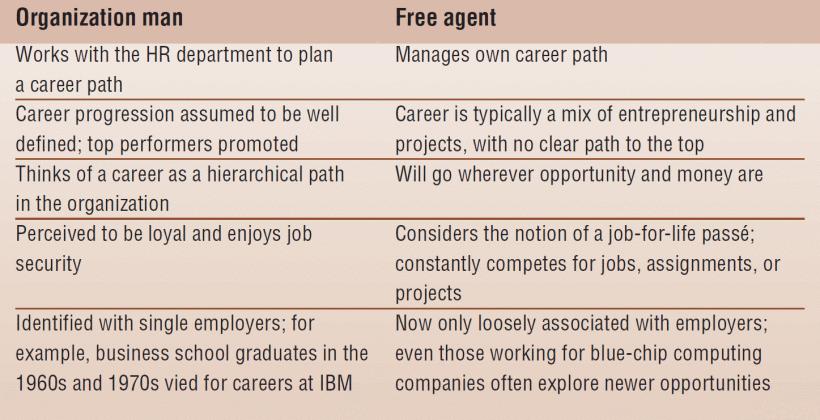
Table 1 shows how careers in IT consulting have evolved from lifelong single-employer jobs to a free-agent model. Y2K, the Internet, and the dotcom boom brought a whole legion of professionals from varied backgrounds into the computing field. Some joined traditional companies' IT departments, but many decided to explore careers in consulting. The industry also saw the appearance of a whole array of consulting companies, ranging from small shops with a handful of consultants to large system integrators like IBM and EDS.
Table 1. Organization man versus free agent.
The industry afforded a gamut of vocational choices, from short-term projects spanning a few weeks to longterm maintenance projects lasting a few years. Along the way, computing professionals also realized that the industry was becoming increasingly market driven. Thus, getting certified in vendor technologies, being associated with professional bodies—including the IEEE and ACM—and building expertise in current skills gave them more leverage than being associated with a blue-chip employer.
Individual computing professionals have also shown their market savvy by selling themselves as experts in Cobol, ERP, Java,.NET, the Web, and other technologies the market demands, sometimes juggling multiple hats at once. The career trajectory of many computing professionals has begun to resemble that of free agents who take on a series of projects or assignments that help them market their skills to the highest bidder.
The computing professional may be taking a page from a trend already established by other professionals in vocations such as law, medicine, finance, and academia. Lawyers and financial analysts have long known that their real allegiance is to the profession rather than to individual organizations or companies where they work. Being a corporate attorney or a corporate financial analyst is perceived to be less glamorous and financially rewarding than working for a high-profile partnership or, better still, founding one's own firm. Academicians and professors have refined moonlighting into an art—consulting for large corporations, helping their clients understand and incorporate the latest academic and research ideas, and raking in huge fees—even while continuing their day job of teaching and spearheading university research.
By building and maintaining a brand and attracting a steady stream of clients, free-agent professionals can thrive by following the models established by those in the following fields:
lawyers and legal professionals;
chartered accountants and financial professionals;
doctors and medical specialists;
Management consultants;
architects, builders, masons, and craftsmen;
artists, performers, singers, and musicians;
freelance writers and columnists;
athletes and sports stars; and
academicians and professors who moonlight as consultants.
Computing professionals now realize that they need to take active charge of the direction in which their careers are headed. Whether they view a career as a series of assignments or as a mix of traditional jobs and moonlighting, all computing professionals must actively take control of their career. Today's companies value people based on what they bring to the project, assignment, or work task rather than how many years these professionals have spent at one job. Quoting Drucker again:
The challenges of managing oneself may seem obvious, if not elementary. And the answers may seem self-evident to the point of appearing naive. But managing oneself requires new and unprecedented things from the individual, and especially from the knowledge worker. In effect, managing oneself demands that each knowledge worker think and behave like a chief executive officer…. Every existing society, even the most individualistic one, takes two things for granted, if only subconsciously: that organizations outlive workers, and that most people stay put…. But today the opposite is true. Knowledge workers outlive organizations, and they are mobile. The need to manage oneself is therefore creating a revolution in human affairs.
Academia pays close attention to these industry trends. Engineering schools and universities, especially in the West, have begun introducing technologists to entrepreneurship and business fundamentals. Further, the students graduating into the field of computing are beginning to realize that courses in entrepreneurship will play an essential role in helping them manage their lives and careers.
As professionals in a workforce with evolving expectations of the employer-employee relationship, most of us will need to acquire and apply entrepreneurial and business management skills to manage our careers. Our career trajectories will thus depend on constant marketing and networking rather than climbing the ladder of a predefined career track.
If you have any connection to America – as a US citizen, immigrant, an H1 worker or a foreign student or an Indian American expat like my, you cannot escape the politics and upcoming presidential elections.
As I get ready to request my absentee ballot via post for the US Federal elections, for myself and my wife, I am also reflecting on a constituency that is watching the elections from sidelines since the elections could impact their lives and careers. I know, since I jumped through the H1 B and immigration hoops for years before eventually becoming a naturalized
citizen.
Nearly a million Indians live and work in the US on H1 B
visas and another half-million Indian students are studying in schools and
universities across America. Most Indian students move to American universities in the
hopes of eventually finding an employer who will sponsor their H1 Visa. In the
meantime millions of H1B visa holders are looking at decades long wait for a
green card that will let them live and work in America permanently.
None of us has a crystal ball on the outcome of the
elections or what the new administration will usher, but the position of the
frontrunners are clear – Both President Biden and former president Trump are
trying to sound tough and vocal on immigration.
Make no mistake, US immigration reform is a complex
legislation that President and congress – Senators and Congressmen have to
agree on. But in the meantime, the president also has executive powers to take
decisions. Take the example of the issue of work-permits for spouses of H1 Visa
holders.
So what should Indians do while watching the US election
drama unfold? While non-citizen immigrants don’t have a vote, they certainly
have the clout.
Lean on your Indian American friends, colleagues and
community to influence folks who do have a vote
Stand up and voice your opinion as future citizen and voters
– after all you are legal immigrants on an eventual path to citizenship
Voice your opinion with your corporate lobbyists – tech
companies like Google, Microsoft, Apple and other silicon valley giants have
strong lobbying groups. Voice our concerns there to have it heard by American
lawmakers
Highlight the economic prowess as taxpayers in America and
influence your lawmakers “back home”
Indian leaders are signing off on Billions of dollars in
American imports. In 2022, India's imports from the United States were worth
over $47 billion.Arms, Drones and
Satellite technologies. Billions of dollars in Aircraft purchases from Boeing,
While non-citizen immigrants don’t have a vote, they
certainly have the clout. Make your voice count.
Not a day goes by without a headline grabbing story about Artificial Intelligence (AI) and its innovative application. Not surprisingly, I was fascinated to “see” the “AI version” of former Pakistani Prime Minister Imran Khan’s victory speech posted on Youtube after his party won an unprecedented election. What was remarkable was the innovative use of technology that led to this win.
Mr. Khan who is currently serving a sentence on charges of corruption holed up in a Pakistani prison wasn’t allowed to contest elections or even engage directly in any political communications. But in a groundbreaking move that marked a paradigm shift in political communication, he continued to rally his troops via AI morphed images and synthesized speeches crafted with the assistance of cutting-edge artificial intelligence tools. In a grand finale, he took to the “virtual” stage, thanking his audience in an “AI version” of what he termed “an unprecedented fightback from the nation.”
This is indeed a fascinating application of AI/ML in politics out in the open – a topic at the intersection of Technology, Business, Government and Society. The mainstream media around the world and political analysts took note. The New York Times describes the victory speech as “the mellow, slightly robotic voice said in the minute-long video, which used historical images and footage of Mr. Khan and bore a disclaimer about its A.I. origins.”
Innovative use of AI tools and technologies
Using sophisticated deep learning models, AI can now analyze and synthesize audio and visual content with remarkable accuracy which are hard to distinguish from the real-version with a naked eye. This capability enables the creation of videos that seamlessly blend real and virtual elements, blurring the lines between fiction and reality. From realistic computer-generated characters to immersive virtual environments, AI-generated videos push the boundaries of what was once deemed impossible in visual storytelling.
Hollywood has long used AI-generated videos in streamlining the film making process, especially to generate special-effects that wow us. With the ability to automate certain tasks, such as scene composition, special effects, and even scriptwriting, AI can significantly reduce production timelines and costs. Filmmakers and content creators can leverage these technologies to bring their creative visions to life more efficiently, fostering a new era of innovation in the entertainment industry. The technology emerged from Hollywood to social media and is now into the mainstream influencing mindshare in politics and democracies.
Influencing mindshare
Imran Khan’s use of AI-generated videos to broadcast political speeches are at the intersection of innovation and society. These are not merely a string of algorithmically generated sentences but a reflection of the leader’s vision, values, and commitment to progress in Khan’s ‘voice’. The AI system, trained on vast datasets encompassing Khan’s speeches, policy documents, and public addresses, successfully captured the essence of his distinctive communication style.
Critics and supporters alike lauded the innovation, acknowledging the efficiency and effectiveness of AI-generated speeches. While skeptics questioned the authenticity and spontaneity of the delivery, supporters emphasized the potential for AI to enhance and amplify the impact of political messaging.
While ethicists are lauding the disclaimer that came with Khan’s speeches, one wonders about all DeepFakes circulating without a similar notice. What if Mr. Khan’s team had used the same technology to generate DeepFakes of his political opponent, Nawaz Sharif, in a compromising position with Bollowood starlet or worse making blasphemous speeches?
The Ethics
The widespread use of AI-generated videos, especially to influence large groups of people raises ethical considerations and challenges. The potential for deepfake technology, where AI can convincingly manipulate footage to depict events that never occurred or alter the words and actions of individuals, introduces concerns about misinformation and trust in the digital age.
As these technologies advance, concerns regarding misinformation, privacy invasion, and the potential misuse of AI-generated content have emerged, prompting a critical examination of the ethical implications surrounding this cutting-edge field. Striking a balance between the creative potential of AI-generated videos and the responsible use of this technology becomes crucial in navigating the ethical landscape.
While the technologies to detect deepfakes continue to advance at a fast pace, bad actors bank on the virality of social media. It is almost like a game of real-life whack-a-mole where the good-guys try to catch-up and swat deepfakes sprouting around. The bad guys who create deepfakes bank on their viral spread on social platforms. Attempts to later contradict them with facts backed by digital proof of tampering can’t undo the widespread damage done.
Of course, this is not the last word on the topic. We are sure to see armchair-critics of politics continue to debate these applications as citizens of two other major Democracies – the largest and the oldest – go to polls this year. The innovative and ‘ethical’ use of the tools by Imran Khan’s team during the Pakistani elections are being studied by political wonks and consultants around the world.