Rancho Cucamonga, California — 14-year-old Shrey Parikh has won the 98th annual Scripps National Spelling Bee, defeating 12-year-old Ishaan Gupta in a lightning-round tiebreaker to become the 111th champion in the competition's history.
The Championship Spell-Off
Parikh and Gupta were the final two spellers standing after a tense competition that culminated in a 90-second "spell-off" on Thursday night. In the tiebreaker, each speller raced to spell as many words as possible:
Parikh's dominant performance turned what began as a high-quality final into a conclusive victory, earning him the title of best young speller in the English language.
Champion's Profile
Runner-Up: Ishaan Gupta
Prize Package
Parikh's victory comes with substantial rewards:
$52,500 cash prize
Reference works from Encyclopaedia Britannica and Merriam-Webster
Custom trophy and commemorative medal
$1,000 in Delta Air Lines flight credits
A Remarkable Spelling Journey
This victory marks a significant comeback for Parikh, who was the runner-up just two years ago in 2024, finishing behind Faizan Zaki. Zaki went on to win the 2025 Bee, making this year's final particularly meaningful as Parikh returned to claim the championship.
Competition Details
The 2026 Bee featured 247 spellers representing all 50 states, the District of Columbia, three U.S. territories, and five countries: the Bahamas, Canada, Ghana, Nigeria, and the United Arab Emirates. After preliminary rounds, 167 spellers advanced, with 95 reaching the quarterfinals following the written spelling and vocabulary test.
Eight finalists ultimately reached Thursday's finals, with competitors advancing through regional bees hosted by sponsors nationwide. To compete, spellers must not have advanced beyond eighth grade or be older than 15.spellingbee+1
Historical Context
Although this was the 98th Scripps National Spelling Bee, Parikh is officially the 111th champion due to multiple ties in the competition's history, including an eight-way tie in 2019. The Bee was first held in 1925 and has been canceled only twice: during World War II (1943–1945) and the COVID-19 pandemic (2020). This year marked the competition's return to Constitution Hall in Washington, D.C., a few blocks from the White House.
Beloved author Ruskin Bond marked his 92nd birthday in the hills of Dehradun, surrounded by eager young readers, chirping birds, and the launch of his latest collection, *All-Time Favourite Friendship Stories*. Held a day before his official birthday, the event drew about 100 children from nearby schools and their teachers, turning a simple book launch into a warm, multigenerational celebration of the man and his work.
The new book gathers 25 of Bond’s most cherished stories on friendship, spanning his long career and highlighting the quiet magic of companionship in all its forms: from unexpected bonds between children and animals to deep, lasting friendships between people who find each other almost by accident. Penguin Random House India’s Children’s Division, including publisher Sohini Mitra and Puffin’s Kavya Wahi, helped organise the launch, underscoring a publishing relationship that now stretches across two generations of readers.
For decades, Bond’s birthday in Dehradun has been marked by the release of a fresh title, making it one of the gentlest traditions in Indian publishing. What began as an annual release has evolved into a small cultural rite: children who once read his stories with their parents now attend with their own children, some of them participating in quizzes and readings during the festivities.
Surrounded by members of his immediate family, including his granddaughter Srishti and grandson Siddharth, Bond spoke about how friendship has shaped his life. “My entire life has been woven around the strong bonds of friendship that have grown around me,” he said, describing close relationships that have often blurred into family. “Shrishti and Siddharth, Rakesh and Beena and others have all grown up in front of me, and family means friendship and friendship means family. Love embraces us all.”
Even as he acknowledged the challenges of ageing, his voice remained light and pragmatic. Now living in Dehradun for health reasons, Bond explained that he can no longer walk as much as he would like, and his eyesight has made it harder to write by hand. Yet he continues to produce stories by dictating them, joking that “every day should be a birthday” as he cut into a cake designed to resemble his new book’s cover.
Publishers and readers alike framed the launch as a quiet continuation of a much‑loved literary legacy. Sohini Mitra described Bond’s stories as a “cherished part” of Penguin’s publishing journey, noting that *All-Time Favourite Friendship Stories* brings together some of his most heartfelt tales to remind readers that friendship often arrives in the most unexpected places. For the latest generation of Indian children, many of whom grew up on screens, the collection offers a gentle counterpoint: stories that celebrate walks in the hills, stray animals, and the small, unplanned moments that become the most important relationships in life.
As birthday tributes poured in from across India and beyond, Dehradun stood as a fitting stage for a writer whose life and work remain inseparable from its valleys, trees, and small towns. At 92, Ruskin Bond continues to write with the same unhurried warmth that first drew readers in the 1950s, quietly arguing that, in the end, the smallest things - a friend’s unexpected visit, a quiet hillside, a handwritten story are very often the only things that truly matter.
A story of two tweets, a million–dollar ghost, and ten unexpected arrests. This story connects them through one sleepless weekend in Boston’s Indian diaspora and the FBI’s timelines.
Source
The Million-Dollar Ghost
On a gray March morning, the news broke like a crack of thunder through immigrant WhatsApp groups in New Jersey, Texas, and Gujarat.
Source
The FBI had raised the reward to up to $1,000,000 for information leading to the arrest of Ten Most Wanted fugitive Bhadreshkumar Patel, the man accused of killing his 21-year-old wife in a Maryland Dunkin’ Donuts and then vanishing into the folds of the diaspora.
Source
For eleven years he had been more rumor than man: a name whispered in Patel motel lobbies, a face half-remembered at garba nights, always “someone’s cousin’s friend” who had disappeared after “a family matter” went bad.
Source
Mothers used him as a cautionary tale about rage and marriage; fathers mentioned him in bitter asides about how one man’s violence could stain an entire community.
Source
Now the number—1,000,000—glared from phones like a second sun.
Source
Some saw justice finally gathering momentum; others saw danger, the fear that any brown man with the wrong haircut and the right accent might be stopped, questioned, or worse.
Source
FBI Boston announced that its Violent Crimes Task Force had arrested ten Indian nationals across Massachusetts, Kentucky, Missouri, and Ohio for allegedly participating in a sprawling criminal scheme.
Source
The details were still sketchy to the public—fraud and violence braided together, money moving through shell accounts, victims scattered across states—but the headline was enough: “10 Indian nationals arrested.”
Source
In Indian grocery stores in Burlington and Somerville, the story ran under softer fluorescent lights, retold with long pauses and lowered voices between the coriander and the garam masala aisle.
Source
In the span of forty-eight hours, two different narratives collided: one about a singular, almost mythic fugitive whose violence had started in a back room of a donut shop, the other about a network of suspects woven into quiet American towns.
Source
For those who lived in between—Indian by memory, American by paperwork—the tweets felt less like separate announcements and more like coordinates on the same map.
Source
Rhea’s Timeline
Rhea, a 29-year-old data engineer in Cambridge, first saw the million-dollar tweet during a late-night doomscroll between code deploys.
Source
She remembered the old articles she’d read years ago: the 2015 killing, the Dunkin’ Donuts in Hanover, the young wife whose American dream ended behind a swinging stockroom door.
Source
The FBI had added him to the Ten Most Wanted list in 2017, but over time he had drifted from the headlines into the uneasy folklore of the diaspora.
Source
Two days later, sitting on the Red Line, she refreshed her feed and saw the Boston tweet: ten Indian nationals arrested, Violent Crimes Task Force, multi-state operation.
Source
Two Threads, One Fear
At lunch, Rhea walked to an Indian café near Kendall Square, where the TV silently looped cable news while subtitles raced beneath.
Source
The local anchor mentioned the arrests in a brief segment—stock footage of FBI jackets, a map with glowing dots over four states, the line “all of them Indian nationals” delivered with clinical emphasis.
Source
An older man at the next table muttered, “First that Patel fellow on Most Wanted, now this. They’ll look at all of us like criminals.”
Source
His friend replied, “They already do. It’s just that now they have fresh headlines.”
The Anonymous Tip
Two weeks after the reward announcement, a tip arrived through the FBI’s online portal.
Source
The person didn’t give a name, only an email address that looked like any other throwaway account.
They wrote about a man who avoided cameras, who changed jobs often, who never talked about his past but always read news from home.
Source
Threads Still Open
On a quiet Sunday, Rhea sat by the Charles River and opened the million-dollar tweet again, then the Boston arrests one.
Source
The quotes, replies, and reposts had multiplied: some angry, some defensive, some celebrating, some grieving.
Somewhere in the Midwest, a man who might or might not be Bhadreshkumar Patel walked into a small store, careful to keep his face away from the camera above the counter.
Source
Between them stretched a digital trail of posts and appeals, headlines and case files, rumors and late-night conversations in far-flung Indian kitchens.
Source
The story of those two tweets wasn’t finished; it had only marked the points where the hidden work of justice briefly surfaced for everyone to see.
Source
TCS's work culture is legendary, and WITCH veterans like me, like scores of tech professionals credit these giants - employing over a million - for their foothold in the industry. But this post is not about work at TCS’, but rather their marketing outreach.
Many of us have heard and seen clips of TCS sponsoring marathons in major global centres including the TCS New York City Marathon, London and the newly inducted TCS Sydney Marathon – all an effort by Corporate Marketing to get the brand out there. Until this year I hadn’t heard of yet another outreach in India - the TCS InQuizitive, a quiz series for highschoolers.
TCS InQuizitive, a national quiz for grades 8-12, covers current affairs, science, tech, business, arts, and culture to build critical thinking. My son and his partner reached the Bengaluru regionals in August 2025, a buzzing event at Chowdiah Memorial Hall with 546 teams from 93 schools across Bengaluru and nearby cities like Mysore and Goa.
Tata branding shone through SWAG: Taj Yeshwanthpur lunch vouchers, ₹25K Chroma vouchers, and Starbucks goodies - ensuring kids link these perks to the Tata Brand. The intent of the event and goodies was simple - If not anything else, the kids of his generation will remember the assorted companies under the TATA umbrella.
While I didn’t accompany him for the finals in Mumbai, I followed up online. If you think getting 12 regional finalists and their teachers from around the country to travel to Mumbai is not-trivial exercise, add the curve ball thrown over the Indigo fiasco. To their credit, TCS and their travel agents scrambled to arrange Air India bookings – another TATA brand - for affected participants. Son’s return trip that was scheduled on Indigo on 7th Dec. One can imagine the cost of doing that alone.
The finals took place at The President IHCL SeleQtions - another Tata group gem - with the vibrant quiz host Giri and his team flown in to orchestrate the event.
From chauffeured pickup – with guys holding placard of participant’s names at the Airport – to a drop back, the kids gathered memories of a “five star” experience that is sure to last a lifetime.
Engaging youth through non-digital endeavours is commendable in today's screen-dominated world. As a parent, the well-orchestrated TCS InQuizitive series - from Bengaluru regionals to the Mumbai finale - left me deeply impressed. As a former WITCH veteran, I was captivated by TCS's savvy offline branding efforts that stand out amid the digital deluge.
My family has known Mahalinga Ganapadigal for decades, and I was delighted when Mami came by with her daughter to personally invite us to his Sadabhishekam celebration. In an era dominated by WhatsApp messages and e-invites, personally inviting guests to partake in celebrations is a rare and precious tradition. It is a beautiful throwback to a bygone era of genteel custom, reflecting both class and deep respect for age-old traditions.
Ganapadigal, a vedic scholar and priest, has been a spiritual confidant to my father for many years. He officiated the upanayanam ceremonies for my brother and me nearly three decades ago, and he did the same for my son just a year ago – a true full circle in life.
The invitation card mentioned that the event would be held at Havyaka Bhavana in Malleshwaram, a spacious and pleasant hall in the heart of the city. I anticipated a sizable crowd, but Suja, my wife, and I were truly blown away to see over a thousand people grace the occasion.
The Sahasrachandra Darsana Shanti, which signifies that Ganapadigal has witnessed 1,000 full moons, was truly a celebration of his life. The hundreds of well-wishers present were a testament to how deeply he has touched so many lives. The ceremony was deeply traditional, featuring a dozen Brahmins chanting Vedic hymns accompanied by various homas (fire rituals) such as Ayusha Homa, Mrityunjaya Homa, and Navagraha Homa, all invoking blessings for health and longevity.
Ganapadigal and Mami have been long-standing fixtures at the Shankar Mutt in Malleshwaram, officiating at functions, celebrations, and events. A stickler for punctuality, Ganapadigal expected no mistakes from his associates and was unfailingly punctual, come rain, shine, or Bangalore’s notorious traffic. With Mami by his side, he has been present for nearly all events held at the Mutt complex.
Despite the hectic schedule devoted to the Mutt and rituals, Ganapadigal and Mami still found time to build a home in Vidyaranyapura and raise six children. Their five daughters are well-educated and married into respectable families across the country, including one settled abroad with her husband. Their son is an executive at a pharmaceutical company and is settled in Bengaluru.
Ganapadigal’s energy and inner strength are most visible during the monthly rituals on Ammavasya, Ekadashi, and Pradosham, when dozens of Brahmins join the ceremonies. And did I mention the annual thread-changing ceremony, Yajurveda Upakarma? He hosts 6-8 batches of ceremonies for hundreds of Brahmins, starting at 5:30 in the morning and continuing through the "Homam batch" at noon.
Not surprisingly, hundreds turned up to partake in the celebration of his life. The ceremony and havans were followed by the ritual of the invitees queuing up to offer a small token and seek blessings from the couple.
There’s an old adage that goes: the only certainties in life are death and taxes. And while death is inevitable for all of us, the how, why, and when remain the great unknowns — mysteries that both unsettle and sustain us. What would you do if you knew you had only six months to a year to live? Perhaps try to leave behind a legacy while your body slowly succumbs to the inevitable.
For Paul Kalanithi, an Indian-American neurosurgeon and writer, this wasn’t a philosophical exercise — it was his reality. In the final year of his neurosurgery residency at Stanford, Paul was diagnosed with stage IV lung cancer. Despite the best that modern medicine had to offer, the disease metastasized and spread rapidly. He was told he had less than a year to live.
The diagnosis arrived at the cusp of what should have been the most rewarding phase of his life — a promising career as a neurosurgeon and academic researcher. Paul and his physician wife, Lucy, were left reeling. But instead of retreating into despair, they chose to face the future with clarity and courage. This is not a book about “fighting cancer” or “winning battles.” It is, instead, a reflective and beautifully written chronicle of a life lived deeply — even as it draws to a close.
An English literature major, Paul brings lyrical sensitivity and philosophical inquiry to his writing. He retraces his journey from the son of Indian immigrants — in a family where a career in medicine was more or less a given — to a passionate lover of literature, and then back again to medicine, where he found a calling in neurosurgery.
Death, though inevitable, is something we rarely confront until it’s at our doorstep. Even for those of us who have experienced loss, the finality of our own end often feels too abstract to contemplate — a vague event lurking somewhere in the distant future. And perhaps that’s for the best. Until, of course, fate flips the hourglass and you can see the sand slipping away.
In the second half of When Breath Becomes Air, Paul offers an unflinching account of what it means to live with — and die from — cancer. His initial diagnosis brought cautious optimism, with an experimental drug offering temporary reprieve. But when the tumor returned, larger and more aggressive, Paul and Lucy could no longer pretend to fight it. They weren’t battling cancer; they were learning to live with its timeline. The book doesn’t peddle false hope. It’s not about defiance. It’s about acceptance.
As his condition worsens, Paul begins to write. With insight born of both medical training and lived experience, he documents his transition from doctor to patient. One of the most poignant moments in the book is when Paul removes his surgical coat for the last time — fully aware he will never again step into an operating room. Even more heartbreaking is his account of holding his newborn daughter, his body frail and trembling from chemotherapy.
I have reached an age where I’ve witnessed death — some timely, others tragically premature. And yet, I find myself still unable to fully grasp the inevitable arc of my own life. So I will file away Paul’s tender, searing prose for the time when I, too, must meet Death — and perhaps seek some solace in his words.
In this era of social media, where our attention spans are consumed by bite-sized shorts, clips, and snippets, sitting through a 2–3 hour classical music recital feels like a dying pastime—much to my dismay. Aside from the occasional Coldplay concert that fills stadiums with selfie-snapping spectators, the art of attending live performances seems to be fading fast.
This weekend, Suja and I decided to break our usual routine and drove across town to attend a recital by Vidushi Preeti Sethuraman, a promising young vocalist performing in the Bangalore suburb of Indiranagar. We had budgeted about an hour for the commute, so I wasn’t too surprised when our Ola took a detour-laden 90 minutes through the thick of metropolitan traffic. Thankfully, we arrived just in time for the introductions—and I was captivated from the very first note she rendered.
The beautiful rendition of Jagadananda Karaka had the audience spellbound, with many humming along to Thyagaraja’s Sanskrit kriti. At the end of the piece, Preeti explained how the composer had woven three primary meanings of “Sri” (श्री) into the composition. The singer’s energy was infectious—she engaged the audience with a warm smile, nodded in rhythm to encourage her accompanying artists, and infused every rendition with captivating presence.
Although Suja and I had planned to spend just an hour at the concert before heading to another appointment, the recital drew us in completely. We ended up staying for almost three hours, fully immersed in the experience.
On the way back, Suja reminisced about seeing Preeti—and her sister Aarti, both distant relatives—as little tots. She was fascinated by how “that little one” had blossomed into such an accomplished artist, carrying a mantle passed down through generations of “vidvans”. Suja couldn’t help but feel proud for Preeti’s parents, who had poured their time and energy into nurturing the talent now so visibly in bloom.
While technology and live streaming have made it convenient for us to work from home and pull entertainment into our living rooms, there’s something irreplaceable about dressing up and showing up. Sitting in the audience, making eye contact, and encouraging artists in the moment—this is an experience that no AI, Metaverse avatar, or livestream can replicate. In that sense, the techie in me hopes we remain gloriously art-loving Luddites.
I have been a fan of John Grisham’s legal thrillers for as long as I can remember. A former lawyer who decided to pursue his passion for storytelling, Grisham writes what he knows - about law, and more interestingly how law impacts the lives of people.
Most of Grisham’s stories are set in Clanton and the Parrish nearby in Mississippi and he has been cranking out a novel a year for the past couple of decades. Each of his stories has ended up on best-seller lists selling millions of copies.
His cult-like following was evident during a book signing I attended in Winston Salem, NC about 5-6 years ago. In this era of social media, it was interesting to see a hall packed with people who paid $25-$50 to meet their favorite author. Personal selfies with the man were extra.
The Summons begins with the protagonist, Ray Atlee, a Law professor at the University of Virginia getting a letter from his dad summoning him back to Clanton Mississippi. Ray’s father, “judge” Atlee has been a beloved figure in the town of Clanton for decades and had a falling out with Ray and his brother Forrest. Judge Atlee was dying from cancer, which his estranged sons are acutely aware of.
Ray calls up Forrest to ask if he’d gotten a similar summons from the Judge and Forrest says nonchalantly that he would try to be there. Ray drives 15 hours to Clanton, arriving an hour before the appointed 5 PM appointment.
He knocks on the door of their old family mansion with trepidation, and when he doesn't get a response, enters the house and walks up to the Judge’s study where the old man is sleeping - or so Ray thinks. He gets a diet soda from the fridge waiting for his old man to wake up. When he realizes that the Judge hasn’t moved even after the clock struck five, Ray suspects something is wrong. He makes small sounds to wake up his father and finally feels his pulse to find the Judge is indeed dead.
Although the moment was long in coming, Ray is overwhelmed nevertheless. He is not sure what he must do but decides to walk around the house before calling the coroner and Harry Rex, their family friend.
While rummaging through the Judge’s study, Ray comes across a few filing boxes and on opening one is shocked to find stacks and stacks of 100 dollar bills bundled neatly. Ray’s mind begins to whirl and this discovery accentuates the shock of finding his father dead.
That his rather meticulous, honest, and well-known Judge in Clanton had stacks of three million dollars lying around is enough to raise all kinds of questions in Ray’s mind. But before he can begin to investigate, his immediate impulse is to hide the money before the coroner, police and hordes of visitors begin thronging in. Most importantly, Ray must hide the money from his brother who has been an addict for most of his adult life.
Ray’s search for the truth about the source of this amount and how it came into the Judge’s possession is filled with intrigue in Grisham’s classic narrative.
Spoiler alert: After cheering Ray along on his admirable quest, we the readers are left wondering about the anti-climax.
A novel like this made me reflect on the art and craft of storytelling along with the art of bringing to life the characters that Grisham has mastered. He does all this while taking the readers through the human side of law and lawyers.
I’ve been enjoying audiobooks for over a decade and was thrilled when John Grisham's latest legal thriller, Camino Ghosts, became available in my library. As a longtime Grisham fan who has read most of his thrillers, listening to Whoopi Goldberg’s narration was the icing on the cake.
The story weaves a thread between the past—the saga of a slave ship that brought Nala and crashed off the coast of Florida—and the present-day life of Lovely Jackson, a descendant of those enslaved.
Set on Camino Island, the popular bookseller Bruce Cable shares with local author Mercer Mann the story of Jackson and how a resort developer is scheming to claim ownership of a deserted island. What the developer doesn’t know is that the island holds a remarkable history, and locals believe it is cursed.
Goldberg brings Grisham’s fast-paced narrative to life, making for a mesmerizing audiobook. Another five stars to John Grisham for this legal thriller!
My Wife Suja and I had often discussed visiting the Art of Living (AOL) International Center on Kanakapura Road, especially since our son attends the Sri Sri Ravishankar School in North Bangalore. However, we hadn’t found the right opportunity to go, even though Vijay had made several trips to the Ashram as part of school activities.
Suja’s birthday fell in December. While we went out for lunch to celebrate, we couldn’t plan an extended outing or trip as it coincided with Vijay’s preparation for his board exams. Like most schools, his teachers had placed a strong emphasis on pre-board preparation, and he was deeply immersed in his studies.
While Vijay was engrossed in his studies, Suja and I felt the need for a breather—Suja more so than me. I thought a retreat at the Art of Living (AOL) would make a meaningful and “experiential” gift post birthday/New Year. The idea struck me when I received a mailer from the Art of Living the weekend before her birthday, and we discussed it together. The mailer read:
“The Art of Living Happiness Program can help you rediscover your joy, cope with the stresses of everyday life and become a calmer, more confident you.”
The retreat seemed perfect—it offered Suja a well-deserved respite from the monotony of daily life while doubling as an experiential visit to the Ashram. Although intrigued, Suja agreed to sign up for the program with a touch of trepidation. After all, she hadn’t been on any solo overnight outings, except for occasional trips to visit her mother and sisters in Delhi.
Suja spent the next few days eagerly anticipating the break and meticulously planning the logistics for her outing. While packing her bags, she thoughtfully prepared a menu and an itinerary for me to manage the household—ensuring everything was in order for Vijay, my elderly mother who lives with us, and our energetic Beagle.
The residential program was scheduled for three days, from January 3rd to 5th, with participants required to check in at the Ashram by 9:30 PM on the night of January 2nd. That evening, Suja booked an Ola cab and arrived at the Ashram in plenty of time to settle in for the night.
The next evening, Suja called me and Vijay while waiting to go for dinner. She sounded ambivalent about the first day’s sessions. The initial morning had felt a bit underwhelming, especially after the buildup leading to the workshop. Adjusting to a new bed in an unfamiliar place, along with waking up early for yoga and meditation, added to her discomfort. However, she mentioned the eclectic group of co-participants—many had traveled from across India, and some even from other parts of the world.
During her call on the second day, Suja sounded much more upbeat. She shared how the slow start of the first day had given way to a more engaging pace as the program progressed. The group dynamics—forming, norming, and storming—had begun to settle, and the course structure, designed to gradually immerse participants into the program, started to resonate. By then, Suja had made a few friends and spoke enthusiastically about the serene environment: the sprawling campus, the safe and well-maintained grounds, and the ample space to walk around.
The program was scheduled to conclude early on the third day, as several international participants needed to travel back. I decided to drive down to pick Suja up.
The AOL Ashram campus, spanning 250 acres in South Bangalore, is immaculately maintained. I parked my car in the lot outside the campus and entered through the ‘fountain’ entrance. After calling Suja, she suggested I take a shuttle to Annapurna—the large food court, which also houses a small café. I reached there after lunch, met some of Suja’s new friends, and we enjoyed coffee at the Sri Sri Café just outside the campus.
Suja and I spent some time walking around the campus, admiring the beautifully landscaped grounds and various facilities. Finally, we packed up and began the drive back home, feeling refreshed and content.
Notes from Sujatha’s Reflections After Returning
The program was structured for self-reflection, guided by experienced teachers or coaches who followed a pre-designed schedule.
It is neither overtly religious nor heavily spiritual; the primary focus is to help participants step away from their daily routines and reflect on life and the “bigger picture.”
Many participants joined the program with a specific agenda or a pressing issue they wanted to reflect on.
While participants were encouraged to share their stories with one another, the teachers maintained their focus on imparting techniques. They skillfully deflected queries about individual personal issues, keeping the sessions aligned with the broader objectives of the program.
The program offered participants tools like breathing techniques, kriya and meditation to seek “inner peace” and techniques for coping with life’s stressors, equipping them to return to their daily routines with a fresh perspective.
Designed as a three-day retreat, the program facilitated a journey through the forming, norming, and storming phases of group dynamics, fostering camaraderie among participants.
The AOL center provided food and accommodation, both included as part of the course “donation.”
Almost everyone—including myself—loves to hate and troll a humble brag. Narayana Murthy and his wife are practically the definition of a humble brag in India. Look no further than the (in)famous Kapil Sharma Show, where their sound bites, meant for entertainment, were heavily trolled for months
Let’s start with a few facts: while the founders of Infosys are billionaires, the company has created scores of millionaires among its employees. Back in 2003, when I joined Infosys, employees with an "E number" under 2000 were considered VIPs. (My E# was 20K.) These VIPs were literally vested in peace—employees who held onto their ESOPs and stock grants from the 1990s.
And the millions of non-VIP techies? They launched successful global IT careers, thanks to Infosys. Over the years, Infosys has been a bellwether IT services company, paying rich dividends to shareholders. Not much to troll here.
Full disclosure: I too received “a few” ESOPs upon joining Infosys, and these shares, after vesting, continue to provide me with decent taxable dividends year after year.
Now back to the Trolls
Forget Narayana Murthy’s contributions to offshoring in the 1980s and 1990s that propelled India’s globalization. Instead, we latch onto sound bites like “traveling by economy class” and “70-hour workweek,” which he is most (in)famously known for.
Indians love a good troll session, and the more successful someone is, the easier it becomes for us keyboard warriors to launch off on a tangent.
A billionaire buying a million-dollar property anywhere in the world wouldn’t make headlines, but this is Narayana Murthy—someone we all love to hate. So troll we must.
But folks, the show is over. The 78-year-old billionarie will retire to his multi-million-dollar penthouse with soundproof windows, beyond our earshot.
The other day I was pleasantly surprised to receive a mail
from McGrawHill that a royalty amount was due to me
This brought back memories of the grind in writing the book going
through the editorial cycle and finally holding a copy in hand
My book was published much before the proliferation of self-publication
and eBooks where one can simply push any good, bad or ugly piece of work online
on the largest bookstore in the world with a click of a button. So here are my experiences.
Working with a publisher
Working with a publisher can be an exciting and rewarding experience, but it also requires clear communication, understanding, and patience. When you partner with a publisher, they handle many elements of the publishing process, from editing and design to marketing and distribution. A good publisher brings professional editors who help polish your manuscript, ensuring it’s free of grammatical errors, consistent in style, and engaging for readers. Editors may suggest content edits to improve structure, clarity, and pacing, and it's essential to be open to their feedback to enhance the final product.
About 20 years ago, I was
an active blogger and columnist for Express computers – which I did in addition
to my day-job as an IT manager
One of my popular pieces on
the growth of offshoring IT services caught the attention of editors at McGraw
Hill
They reached out to me and
asked if I could write a book on the topic I had explored in my blog. After all,
working at Infosys, an upstart offshoring company, I was best positioned to
share my insights
McGraw Hill assigned, Deepa
V, an editor who began reviewing my draft narrative for content flow, clarity
and readability.
The publication
One important aspect of working with a publisher is understanding the contract. This document outlines your rights and responsibilities, the publisher’s rights, royalties, and timelines for publication. It’s wise to review it carefully, and even consult a literary agent or lawyer, to ensure you’re comfortable with the terms. Throughout the process, maintaining open communication with your publisher is essential. Publishing can be slow-moving, so staying proactive and responsive can help keep your project on track.
After initial editorial
reviews, Deepa worked with the typesetting team and graphics editor to update images and diagrams I had shared. A cover was selected and we were ready to
move
The initial print run was about 1,000 copies which is normal for non-fiction works
The initial print run quickly sold out since the book was topical – offshoring was just taking off
The next print run was about 5,00 copies
Infosys, my employer and their marketing got interested in this project and assigned Vijay to work with me
Vijay suggested I start an internal corporate blog making me one of the first corporate bloggers in India
Royalty
Book royalties are payments authors receive from the sales of their books, typically calculated as a percentage of the sales price. Royalties are an essential component of the income authors make from their published works, and they’re usually outlined in the publishing contract, specifying the royalty rate, payment schedule, and any specific terms.
Royalty rates can vary significantly depending on the publisher, the format of the book, and the sales channel. For traditionally published print books, royalties often range from 5-15% of the book’s retail price. Hardcover editions typically offer a higher percentage than paperbacks. For ebooks, royalties are generally higher, often ranging from 25-50% of the net proceeds, as digital production costs are lower. Self-published authors usually retain a higher percentage of royalties because they take on more of the upfront costs.
McGraw Hill and I had a contract agreeing to a royalty of 15% of the sale price of a copy, which is quite common in the industry
Unlike popular authors with bestsellers no advance was offered
I began receiving annual royalty statements that was exciting for a few years when the book continued to sell well
If you are wondering, for most authors the royalty doesn’t pay the bills.
One time writers, especially in non-fiction genera rarely get rich from royalty
But the reflected glory of being a published author and the egoBoo that comes with it is worth the effort!
·
Writing
Most authors will agree that writing is a lonely endeavor and what keeps you going is a muse and the urge to finish the project. You need to write what you know and you are passionate about
The real effort begins after the book is published –
Thousands of books are added to marketplaces like Amazon every day. How do you stand out?
Authors must hustle to ensure that the book stands out in the crowded marketplace
As an old Chinese saying goes - you might make the best candle in the world but your neighbors will buy it only if they know about it.
In my decades long career in corporate world, I have never been a workaholic but have worked with many such managers. I learnt to stick my personal balance early on
If you are like me, you've got to remember the basics
Ignore it when your managers quotes leaders like Narayana Murthy when they preach about "70 hour workweek"
That's not everyone’s cup of tea
Your health is the most precious asset you have
Listen to your body – it will send clear signs to if it is on the verge of a breakdown
You are dispensable in a job; and some managers will let you go if you aren’t a workaholic like them
Remember, you are free to chose a job that fits your personal goals and health
Some people are workaholics
Some people can take on more stress than others - For instance, those recruited as marine commandos in military or a few managers in the corporate world like Steve Jobs or Elon Musk who tweets night and day in addition to designing EVs and rockets
Some business leaders are willing to sacrifice everything for a professional goal
Be ready with a suitcase packed to travel 3-4 times a month
Be ready for calls and meetings any time of the day or night
The rewards are tremendous – fast track promotions, making a EY or Big-5 Partner at 30, ESOPs and bonuses, bragging rights for parents etc etc
The two movies Aadujeevitham and Dunki hold a mirror to the desperation some Indian youth have to get out of India and seek opportunities in foreign shores. Such moves can sometimes backfire as the movies vividly portray.
Drama in Real life - Aadujeevitham or The Goat Life is a 2024 Malayalam-language survival drama film written, directed, and co-produced by Blessy. It is an adaptation of the 2008 best-selling Malayalam novel Aadujeevitham by Benyamin, which is based on the real-life story of Najeeb, a Malayali immigrant laborer, one among thousands of Indians who were forced into slavery in Saudi Arabia as goatherds on secluded farms in the deserts by the native Arabs.
A few days ago, I was reflecting on completing five years as an Enterprise Architecture (EA) for a multinational, Medtronic. The tenure has been dynamic
I was hired into an Offshore Development Center (ODC) when it was in a growth trajectory.
I had a dual focus – building teams in ODC and enabling Business Partners in Asia Pacific
Strategy shifted when the leaders decided to outsource the ODC to a vendor
My focus continued to be on APAC working with global EAs
CIO left the organization - Global EA function was disbanded. A few roles eliminated while others (including me) remained focused on our domains and regions
A new CIO came on board
The company hired another EA Leader who is bringing global teams together
The new CIO wants has a mandate to resurrect the ODC strategy in India, coming a full circle
While riding waves of internal changes, the business continues to digitize and there is a continuum of technology evaluation and investments in roadmap realization. I continue to be the ‘trusted technology advisor’ to my stakeholders and business partners.
This also brings back the key question Architects sometimes muse about
What is the average tenure of an EA?
Every new functional leader, CxO and CIO will want to leave their footprint in the organization. An EA will either align with the changes or look for greener pastures
Some EAs will seize transformations and take on other internal roles
Some will move to other organizations looking for roles that align with their personal aspirations
A few may continue a longer tenure focused on their work-life balance
There is no set tenure, and it really depends on the organization and individual’s alignment with the changes
The other day while cleaning an old shelf, my son came
across a medallion and he asked me about it. “Oh, it’s your grandpa’s Raksha
Medal from 1965,” I said.
“Did Krishnamoorthy thata actually fight the Chinese
in that war?” He asked. “Was he issued a gun when he was in the Air Force?” he continued excitedly recalling scenes from the Bollywood movies.
Yes and no, I hummed and hawed.
I tried explaining that my dad was indeed posted at an Air
Base that provided Air support to our troops facing the enemy. And for this
service, he and other servicemen were awarded the Raksha Medal.
And then I went on to reflect on the real reason he was my
hero and role model.
Born in Batalagundu, a small town in South India that might just have been the inspiration for RK Narayan’s Malgudi, he grew up in a rather large brahmin agrarian family. When he did exceptionally well at school, he was offered a scholarship to study at a college in a nearby district and a ticket out of the small town. While studying for his bachelors, a lecturer suggested that he join the Indian Air force that was recruiting English speaking graduates for its education instructor’s trade.
Shortly after training and donning his Seargent’s stripes, he was deployed to the Air Base at the border to prepare for the Chinese aggression. And this is how, as a young Seargent, he was awarded the Raksha Medal.
He wasn’t content to continue the life of an enlisted airman and set his sights higher - He would be commissioned as an officer before he married the love of his life, whom he had been wooing since his college days.
He failed the internal services selection board several times before he cracked the SSB to become a “Class A” Gazetted officer with the rank of a Pilot Officer – the first from his town. The month after his officer’s training he married my mother, but just as the couple was readying to enjoy matrimonial bliss, service beckoned. All servicemen were requisitioned to the border, this time to prepare for the aggression from the neighbor to the west. By then, my mother who was pregnant with me, her first son had to return to Batalagundu where I was born.
Dad’s eventful service over the years took us to the far corners of the country – from Bagdogra near Darjeeling where my brother was born, to Jodhpur in Rajasthan where we enjoyed three years of the Rajput hospitality and a number of other memorable stops in between.
Dad would fondly remember his secondment to command a Liaison Unit (LU) – the intelligence wing of the Air Force – during that stint. This was one posting where we stayed in a suburb in town outside the sprawling Air-base, not in the regular quarters and most of my dad’s tenure was in his civvies, not his service uniform. Watching reruns of the sleuths corner the enemy within and outside services in tele-serials like NCIS with him would always give me the goosebumps, when some episodes would mimic war stories from the LU days.
That experience in LU would follow him when he was posted in Bengaluru – as this was during the height of the Indian deployment of the Peace Keeping Force (IPKF) in Sri Lanka. That he was an officer of Tamil origin with an intelligence background didn’t go unnoticed by the military brass, and he was drafted for that endeavor.
After 35 years of eventful service, he decided to spend his
sunset years in the retirement paradise, which is how Bangalore was known then.
During his ‘retirement,’ he continued to consul eligible youth interested in
joining the services and many enlisted servicemen aspiring to be promoted to
commissioned officer would seek his guidance in tuning their efforts. A
small-town boy who retired as a proud Squadron Leader was indeed a role model
to aspire to.
That old soldier didn’t die, he merely faded away at the
‘ripe old’ age of 82, nearly six years ago.
Wojciech Cellary brought out a key point in his column on “The Profession's Role in the Global Information Society” (Sept. 2003, pp. 124, 122–123): Computing professionals continually face exclusion from their work because digital technology advances so swiftly. Along with this risk, changes in the global information society have led to a shift in the computing professional's role from “organization man” to free agent. Renowned management guru Peter Drucker outlined this trend in “Managing Oneself” (Harvard Business Journal, March-April 1999, pp. 65–74). Drucker advises professionals, “… and we will have to stay mentally alert and engaged during a 50-year working life, which means knowing how and when to change the work we do.”
The Organization Man
The traditional concept of the computing profession originated just after World War II, when most Western nations enjoyed a long growth spell. To cater to the emerging needs of the postwar market, corporations built gigantic factories to manufacture products and serve consumer needs. To manage these operations, organizations also started automating their systems with computers. Spurred by this growth in manufacturing productivity, governments, financial institutions, and retailers began to automate their systems as well. During this period, William H. Whyte wrote his much acclaimed book, The Organization Man (University of Pennsylvania Press, 2002), and the term soon caught the fancy of an entire generation of working professionals. Whyte defines organization men as
… the ones of our middle class who have left home, spiritually as well as physically, to take the vows of organization life, and it is they who are the mind and soul of our great self-perpetuating institutions. In a system that makes such hazy terminology as “junior executive” psychologically necessary, they are of the staff as much as the line, and most are destined to live poised in a middle area that still awaits a satisfactory euphemism. But they are the dominant members of our society nonetheless….
Note that Whyte wrote his book during an age when men constituted the bulk of the white-collar workforce, and I will not attempt to be politically correct by using the term organization people here.
To thrive in a rapidly changing world, computing professionals must become free agents.
For nearly half a century after the book appeared, the organization man typified the professional. In most parts of the world, huge corporations—private, public, and government-owned—employed hundreds of thousands of organization men. That era also saw the rise of the computing professional, personified by legions of IBM employees clad in white shirt and tie. Endless movies idolized devoted company men in gray flannel suits and the stable life they enjoyed. Most white-collar professionals across the world sought and could aspire to this American Dream of a good education that led to a good job, a house in the suburbs, and a wife and kids. During this age the public regarded corporations with reverence and deference, a topic analyzed by authors like Fred Harmon and Garry Jacobs, who note in their book The Vital Difference (Amacom, 1985) that “Ma Bell [AT&T] became the ultimate symbol of a benevolent corporation working in and for the public interest.”
Death of the Organization Man
The corporate world experienced a radical transformation in the late 1980s and early 1990s, when cost cutting, downsizing, and rightsizing became the new mantra. Corporations across the globe transformed from benevolent entities to profit centers driven by the interests of their stockholders.
This left the concept of the organization man dying if not completely dead. The most visible cornerstone of the organization man's existence—life-time employment—eroded as well. Globalization of business and management practices also meant the globalization of cost cutting, downsizing, and layoffs. Significantly, even Japanese companies—leading proponents of lifetime employment until recently—have revisited their ideals in light of their economy's decade-long downturn. In India, the wave of privatization sweeping through public companies has led to many so-called voluntary retirements. Asian and European companies have followed in their American counterparts' footsteps and now use layoffs as a regular cost-cutting measure.
Individuals have thus begun to realize that even if they wanted to, they could not entrust their career to a single company: Corporations themselves are regularly evolving, transforming, acquiring other businesses or being acquired by them, and sometimes going bankrupt. Professionals are experiencing what Intel cofounder Andy Grove calls a strategic inflexion point (Only The Paranoid Survive, Time Warner, 1999), with the traditional notions of work and career giving way to a new model in which individuals are expected to take responsibility for their own career moves.
Transition to Free Agent
Faced with this new reality, computing professionals have made a fundamental shift in how they view their careers. Traditional organizational hierarchies are giving way to project- and performance-oriented groups and structures, ushering in the era of gold-collar workers. These free agents are highly skilled professionals who owe a greater allegiance to their profession than to the organizations for which they work.
Daniel Pink first extended the term free agent—borrowed from professional sports—to corporate professionals in his book Free Agent Nation (Warner Books, 2002). Pink sees the emergence of moonlighting as one way professionals can hedge their bets in a changing world:
Diversification—that is, an independent worker spreading her risks across a portfolio of projects, clients, skills and customers is the best hedging strategy…. In the Organization Man era, moonlighting was a big no-no, the very name implied that you were doing something illicit concealing your behavior under the cover of darkness. No more. Today, anybody who holds a job and isn't looking for a side gig—or crafting a business plan, writing a screenplay, or setting up shop on eBay—is out of touch. Moonlighting is a way to diversify your human capital investments—and hedge against the risk of your company collapsing or your job disappearing. In some sense, we're all moonlighters, because in every sense, we're all risk managers.
Becoming Free Agents
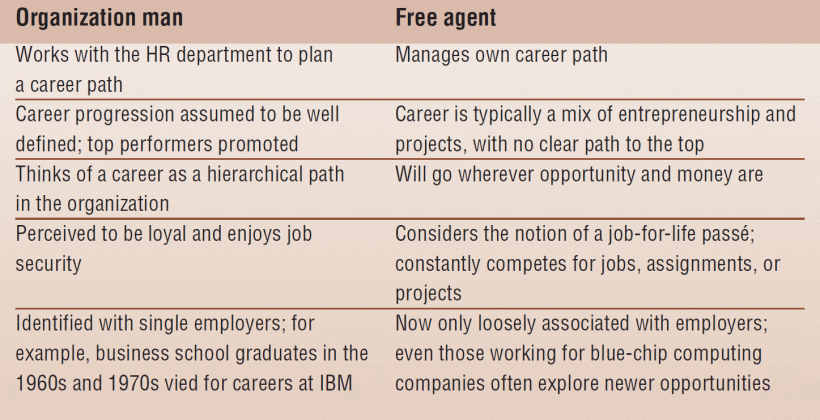
Table 1 shows how careers in IT consulting have evolved from lifelong single-employer jobs to a free-agent model. Y2K, the Internet, and the dotcom boom brought a whole legion of professionals from varied backgrounds into the computing field. Some joined traditional companies' IT departments, but many decided to explore careers in consulting. The industry also saw the appearance of a whole array of consulting companies, ranging from small shops with a handful of consultants to large system integrators like IBM and EDS.
Table 1. Organization man versus free agent.
The industry afforded a gamut of vocational choices, from short-term projects spanning a few weeks to longterm maintenance projects lasting a few years. Along the way, computing professionals also realized that the industry was becoming increasingly market driven. Thus, getting certified in vendor technologies, being associated with professional bodies—including the IEEE and ACM—and building expertise in current skills gave them more leverage than being associated with a blue-chip employer.
Individual computing professionals have also shown their market savvy by selling themselves as experts in Cobol, ERP, Java,.NET, the Web, and other technologies the market demands, sometimes juggling multiple hats at once. The career trajectory of many computing professionals has begun to resemble that of free agents who take on a series of projects or assignments that help them market their skills to the highest bidder.
The computing professional may be taking a page from a trend already established by other professionals in vocations such as law, medicine, finance, and academia. Lawyers and financial analysts have long known that their real allegiance is to the profession rather than to individual organizations or companies where they work. Being a corporate attorney or a corporate financial analyst is perceived to be less glamorous and financially rewarding than working for a high-profile partnership or, better still, founding one's own firm. Academicians and professors have refined moonlighting into an art—consulting for large corporations, helping their clients understand and incorporate the latest academic and research ideas, and raking in huge fees—even while continuing their day job of teaching and spearheading university research.
By building and maintaining a brand and attracting a steady stream of clients, free-agent professionals can thrive by following the models established by those in the following fields:
lawyers and legal professionals;
chartered accountants and financial professionals;
doctors and medical specialists;
Management consultants;
architects, builders, masons, and craftsmen;
artists, performers, singers, and musicians;
freelance writers and columnists;
athletes and sports stars; and
academicians and professors who moonlight as consultants.
Computing professionals now realize that they need to take active charge of the direction in which their careers are headed. Whether they view a career as a series of assignments or as a mix of traditional jobs and moonlighting, all computing professionals must actively take control of their career. Today's companies value people based on what they bring to the project, assignment, or work task rather than how many years these professionals have spent at one job. Quoting Drucker again:
The challenges of managing oneself may seem obvious, if not elementary. And the answers may seem self-evident to the point of appearing naive. But managing oneself requires new and unprecedented things from the individual, and especially from the knowledge worker. In effect, managing oneself demands that each knowledge worker think and behave like a chief executive officer…. Every existing society, even the most individualistic one, takes two things for granted, if only subconsciously: that organizations outlive workers, and that most people stay put…. But today the opposite is true. Knowledge workers outlive organizations, and they are mobile. The need to manage oneself is therefore creating a revolution in human affairs.
Academia pays close attention to these industry trends. Engineering schools and universities, especially in the West, have begun introducing technologists to entrepreneurship and business fundamentals. Further, the students graduating into the field of computing are beginning to realize that courses in entrepreneurship will play an essential role in helping them manage their lives and careers.
As professionals in a workforce with evolving expectations of the employer-employee relationship, most of us will need to acquire and apply entrepreneurial and business management skills to manage our careers. Our career trajectories will thus depend on constant marketing and networking rather than climbing the ladder of a predefined career track.